

Edge AI vs. Cloud AI: Choosing the Right Architecture for Industrial Applications
Neither pure cloud nor pure edge is the right answer for most plants. The useful question is which decisions must be made locally and which can travel.
Amrocor Editorial — Amrocor's own technical explanation of an industry topic. Not a company announcement.

Industrial AI discussions often present edge and cloud as competing options. In practice, production architectures are hybrid, and the engineering work is deciding which decisions belong on the machine and which can be made centrally.
Why This Matters
Architecture is where AI projects become either scalable or brittle. A design that sends every high-rate sensor stream to a cloud endpoint pays for bandwidth, accepts latency it cannot control, and adds an external dependency to a process that may run for years. A design that tries to run everything locally pays for hardware and maintenance capacity it may not need, and loses the fleet-wide view that makes some models better over time.
What Is Changing?
Accelerated industrial computers have moved enough inference capability onto the plant floor that the decision is now a genuine engineering trade-off rather than a budget compromise. At the same time, industrial data governance has matured: retention policies, data residency expectations and auditability now shape architecture as much as cost does.
What It Means for Manufacturers
A practical split usually emerges. Decisions inside a control cycle (reject a part, slow a conveyor, flag an anomaly, issue a stop) belong at the edge, where the latency is known and the line survives a network outage. Functions that aggregate across lines, sites and time (fleet model training, yield analytics, supply-chain optimization, long-horizon scheduling) belong centrally, because that is where the data volume justifies the capacity.
Where Edge Computing Fits
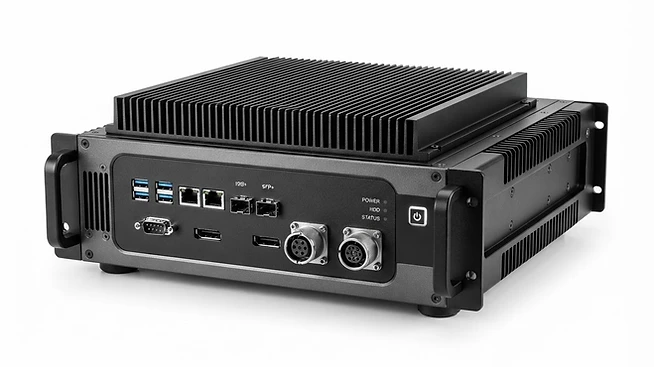
Edge platforms are the enforcement point for the split. They host the low-latency model, buffer and filter data so that only meaningful events travel upstream, and keep working when the link does not. Industrial computers with accelerator options, deterministic networking and industrial environmental ratings make that enforcement reliable rather than experimental.
What Companies Should Consider
Write down the latency budget, the availability requirement and the data retention rule for each AI function before choosing where it runs. Define what happens during a WAN outage. Decide what leaves the plant, in what form, and under whose policy. Include model update and rollback paths, since a remote update that cannot be validated locally is an operational risk. And plan the edge fleet as infrastructure: monitoring and patching.
Amrocor Perspective
Amrocor's position is that the edge and the cloud are complements, and that the boundary between them should be an explicit engineering decision on every project. We supply industrial platforms for the functions that must be decided on the machine, and we recommend keeping centralized infrastructure for training and fleet analytics. The failure mode to plan against is an architecture that treats the network as if it were deterministic.
Conclusion
Choose per function, not per company. When latency, availability and data governance are stated up front, the split between edge and cloud usually becomes obvious, and the resulting architecture is one that production can actually rely on.
Industry Sources
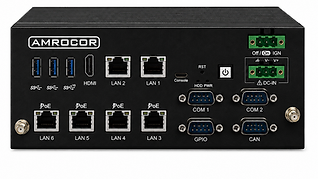
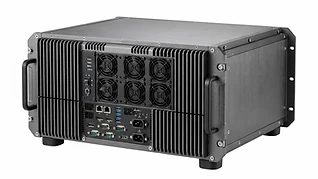
Amrocor Products for This Application


Related Articles

Why Edge AI Is Moving Intelligence Closer to the Factory Floor
Manufacturers are increasingly processing AI workloads closer to machines, sensors and production lines. Here is what that means for real-time industrial applications.
Read Article
How Predictive Maintenance Is Moving Toward Real-Time Edge Intelligence
Condition monitoring has moved from periodic analysis to continuous edge inference. The hard part is turning sensor data into decisions the plant can act on.
Read Article
Physical AI and the Next Generation of Industrial Robotics
Physical AI changes what industrial robots can do, and it changes the computing, safety case and change-control that must sit beside them.
Read ArticleTalk to Amrocor
Send us your application, environment and performance requirements. Our team will recommend the right industrial computing platform for the deployment.