

Why Edge AI Is Moving Intelligence Closer to the Factory Floor
Manufacturers are increasingly processing AI workloads closer to machines, sensors and production lines. Here is what that means for real-time industrial applications.
Industry Reporting — Based on published external industry developments. Amrocor perspective is labelled separately.

Manufacturers are no longer asking whether AI belongs in production. The question has shifted to where inference should run: in a central data center, in a regional cloud, or on the machine itself. For closed-loop control, inspection and safety-adjacent functions, the answer is increasingly the industrial edge.
Why This Matters
Industrial processes are physical. A conveyor does not pause while a request travels to a cloud region, and a weld inspection result that arrives 300 milliseconds late is not a late answer, it is a wrong one. When AI is used to reject a defective part, classify a vibration signature, guide a robot or hold tolerance on a moving web, the value of the model depends entirely on producing an answer inside the machine's own control cycle. That timing constraint, more than model architecture, is what moves intelligence onto the factory floor.
What Is Changing?
Three developments have made on-machine AI practical rather than experimental. First, accelerator hardware that once required a server rack now ships as embedded modules with GPU or NPU engines, mounted directly in industrial computers. Second, model optimization has matured: quantization, pruning and compiled runtimes let a production-grade model run in a fraction of its original footprint. Third, deterministic industrial networking means inference results can be shared with controllers and neighbouring machines on the same time-aware network rather than through a best-effort link.
What It Means for Manufacturers
Moving inference to the machine changes the engineering constraints, and mostly for the better. Camera streams and high-rate sensor data no longer have to leave the plant, which removes bandwidth cost and a significant data-governance question in one step. Lines keep running when the WAN is down. Process data and proprietary models stay inside the facility. The trade-off is that the computing platform itself now sits in a hot, vibrating, electrically noisy environment and must be specified for it.
Where Edge Computing Fits
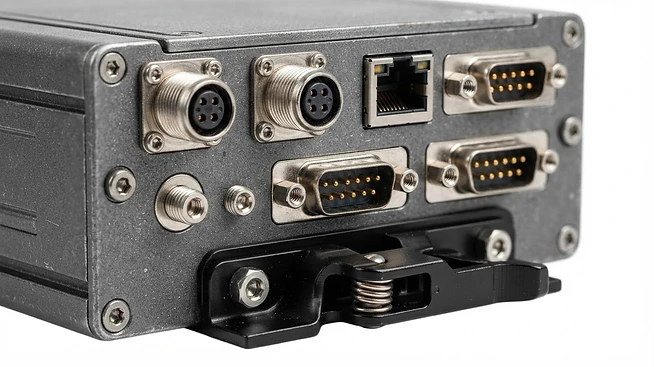
An industrial edge computer is the platform that lets an AI workload live in production: a fanless or filtered enclosure, wide DC input with protection, an extended operating temperature range, shock and vibration tolerance. Accelerator support, NVMe storage for image buffers and models, and industrial networking ports matter as much as the peak performance number on a datasheet.
What Companies Should Consider
Start from the workload, not the hardware. Establish the latency budget for one inference and how many streams or sensors feed it. Then size sustained accelerator throughput and memory, not peak TOPS. Confirm the thermal envelope for the actual cabinet, not a lab bench. Decide what the machine must do when the network or the model is unavailable.
Amrocor Perspective
Amrocor's position is that AI inference belongs in the same enclosure as the control logic wherever the result affects a physical decision. That is a design constraint we treat as fundamental: wide-temperature operation, protected DC power, industrial networking and accelerator options are engineering requirements, not premium add-ons. We also do not claim every workload belongs at the edge. Training, fleet-wide analytics and long-horizon optimization remain better suited to centralized infrastructure, and a realistic architecture usually uses both.
Conclusion
The movement of inference toward the machine is not a fashion. It is the predictable consequence of using AI for decisions that must be made in real time, on data that is difficult or undesirable to ship elsewhere. Manufacturers that plan for that with industrial-grade compute and clear latency budgets will be the ones able to scale AI across lines rather than pilot it on one.
Industry Sources
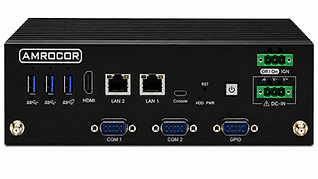
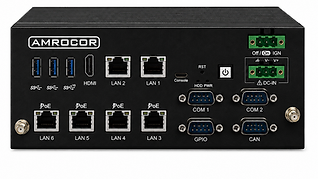
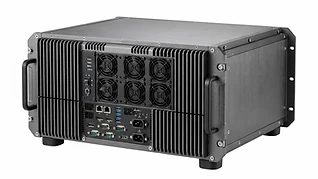
Amrocor Products for This Application



Related Articles

Edge AI vs. Cloud AI: Choosing the Right Architecture for Industrial Applications
Neither pure cloud nor pure edge is the right answer for most plants. The useful question is which decisions must be made locally and which can travel.
Read Article
How Predictive Maintenance Is Moving Toward Real-Time Edge Intelligence
Condition monitoring has moved from periodic analysis to continuous edge inference. The hard part is turning sensor data into decisions the plant can act on.
Read Article
Physical AI and the Next Generation of Industrial Robotics
Physical AI changes what industrial robots can do, and it changes the computing, safety case and change-control that must sit beside them.
Read ArticleTalk to Amrocor
Send us your application, environment and performance requirements. Our team will recommend the right industrial computing platform for the deployment.