

What Manufacturers Should Know About AI-Ready Industrial Computers
An AI-ready industrial computer is a different engineering problem from a standard workstation. Here is how to specify one without over- or under-buying.
Amrocor Editorial — Amrocor's own technical explanation of an industry topic. Not a company announcement.

The phrase 'AI-ready' is used loosely. In industrial practice it describes a computer that can run production inference reliably, in a cabinet or on a machine, under conditions a standard PC was never designed for. Those are engineering requirements, and they are checkable.
Why This Matters
Most AI pilots fail for operational reasons rather than algorithmic ones. Hardware that throttles in a warm cabinet, a power supply that cannot tolerate a dirty 24V rail, or an enclosure that cannot be serviced without stopping the line. Each is more expensive than the accelerator choice that received all the attention during selection.
What Is Changing?
Industrial computing has absorbed the accelerator. Embedded GPU and NPU modules are available in industrial form factors, and PCIe or M.2 expansion in an industrial chassis is no longer unusual. At the same time, plants are consolidating from scattered single-purpose boxes toward fewer, more capable edge nodes that host inference, data acquisition and protocol conversion together.
What It Means for Manufacturers
Specification moves from clock speed to workload behaviour. The question is not 'how fast is the CPU' but 'how many inferences per second can this platform sustain at the cabinet temperature it will actually see, while also serving as a data concentrator'. Two platforms with the same processor can differ by a factor in sustained throughput once thermal design and power delivery are taken into account.
Where Edge Computing Fits
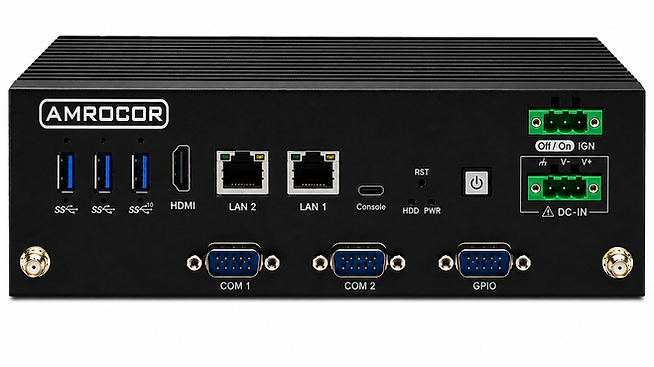
A specification worth building on usually looks like this: wide-range DC input with overvoltage and overcurrent protection, an extended operating temperature range with documented airflow assumptions, shock and vibration ratings, industrial networking and fieldbus support, expansion for an accelerator, NVMe storage sized for image and model retention.
What Companies Should Consider
Profile the workload with real data before choosing. Decide whether the platform will be a single-purpose inference node or a multi-role edge node. Verify the thermal rating for the installed cabinet rather than the datasheet's best case. Confirm how the device behaves on power loss and network loss.
Amrocor Perspective
Amrocor specifies industrial computers around wide-temperature operation, protected DC power, and industrial I/O. We publish platform specifications and recommend validating the selected configuration against the application and installation conditions.
Conclusion
AI-ready is an environment and performance question. Manufacturers should specify the workload, thermal conditions, and hardware interfaces, then validate the system in the intended installation.
Amrocor Products for This Application



Related Articles

How Predictive Maintenance Is Moving Toward Real-Time Edge Intelligence
Condition monitoring has moved from periodic analysis to continuous edge inference. The hard part is turning sensor data into decisions the plant can act on.
Read Article
How GPU-Accelerated Industrial Computers Support Modern AI Workloads
Acceleration extends what a single industrial edge node can run. Sizing it from measured throughput and thermal reality is what makes it dependable.
Read Article
What to Consider When Deploying AI in a Brownfield Manufacturing Environment
Most AI deployments happen in existing plants with legacy control, limited space and no downtime. Scoping the edge island to one decision is what makes it work.
Read ArticleTalk to Amrocor
Send us your application, environment and performance requirements. Our team will recommend the right industrial computing platform for the deployment.