

What to Consider When Deploying AI in a Brownfield Manufacturing Environment
Most AI deployments happen in existing plants with legacy control, limited space and no downtime. Scoping the edge island to one decision is what makes it work.
Amrocor Editorial — Amrocor's own technical explanation of an industry topic. Not a company announcement.

Most industrial AI will not be deployed in new plants. It will be retrofitted into facilities that are twenty, thirty or forty years old, with existing control systems, constrained space and production that cannot stop for a network redesign. Brownfield deployment is the normal case, not the exception.

Why This Matters
The economics of brownfield AI are favourable when the project is scoped to the constraint: one line, one asset class, one decision. They turn negative when the project expands into a plant-wide data programme before it has produced a single operational result. Most stalled industrial AI initiatives stalled at that boundary.
What Is Changing?
Edge computing has made brownfield deployment practical, because the required sensing, inference and local storage can be added as a self-contained island rather than as a plant-wide platform. Cameras, accelerometers, current sensors and an industrial computer can be installed beside existing equipment, produce value locally, and only later be integrated into wider systems.
What It Means for Manufacturers
Constraints become design inputs. Where there is no space in the cabinet, the edge node goes in a field enclosure. Where the control network cannot carry the traffic, the inference stays local and only results travel. Where legacy equipment exposes no data, sensing is added externally. Where the electrical environment is poor, the platform is specified for it. That approach keeps the retrofit contained and reversible.
Where Edge Computing Fits
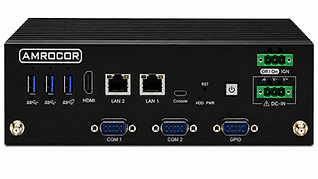
A brownfield edge node has to tolerate what the plant has, not what a data center provides: wide-range DC input from an existing rail, wide temperature operation in an uncooled cabinet, industrial I/O and serial or fieldbus interfaces to equipment that predates Ethernet, and a mounting arrangement that fits the space available. Deterministic networking support is what later allows the island to be joined to a wider architecture without redesign.
What Companies Should Consider
Pick the first use case for operational value, not for strategic breadth. Verify the power and space available before selecting hardware. Add sensing rather than depending on data the legacy control system cannot provide. Keep inference local until the value is proven and the network upgrade is justified. Document the retrofit, including cabling, addresses and model versions, so it can be maintained by the plant rather than by the original project team.
Amrocor Perspective
Amrocor's view is that brownfield retrofits succeed when the edge platform is treated as an appliance: self-contained, specified for the real environment, and installable without touching the existing control architecture. Wide DC input, wide-temperature operation and legacy industrial I/O are the features that make that possible, and they are baseline in platforms intended for existing plants. We advise customers to prove one line before standardizing across a site.
Conclusion
AI in brownfield manufacturing works when it respects the plant's constraints rather than waiting for a modernization programme. A self-contained edge island, specified for the environment and scoped to one decision, is the most reliable way to get from pilot to production in an existing facility.
Amrocor Products for This Application



Related Articles

What Manufacturers Should Know About AI-Ready Industrial Computers
An AI-ready industrial computer is a different engineering problem from a standard workstation. Here is how to specify one without over- or under-buying.
Read Article
How Predictive Maintenance Is Moving Toward Real-Time Edge Intelligence
Condition monitoring has moved from periodic analysis to continuous edge inference. The hard part is turning sensor data into decisions the plant can act on.
Read Article
How GPU-Accelerated Industrial Computers Support Modern AI Workloads
Acceleration extends what a single industrial edge node can run. Sizing it from measured throughput and thermal reality is what makes it dependable.
Read ArticleTalk to Amrocor
Send us your application, environment and performance requirements. Our team will recommend the right industrial computing platform for the deployment.